
Qoheleth's Law: A User's Guide
Read this first...

This is the second installment of posts on the Book of Ecclesiastes. And like a real professional from the News Industry, I’m only giving you enough information to keep you coming back. So relax, and enjoy the ride.
In the first post of this series, I made a positive case for the Book of Ecclesiastes. Specifically, I argued that, rather than a series of unrelated rants about life, it is a work crafted by a Master Teacher, whose title is Qoheleth. It has a discernible structure and theme. It has a starting point, an ending, and even an epilogue.
But what exactly is it for? For whom is it written? And what are we meant to do with it? This is what I want to address in this post. And I’m thinking that it’s all about “Instruction.”
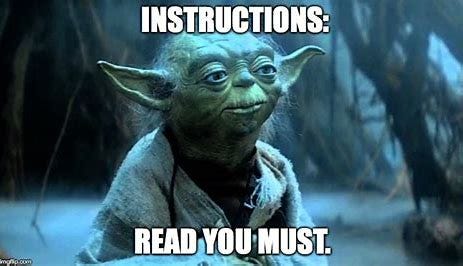
Please don’t be confused. The picture above is not that of Qoheleth (though he would qualify for the job). But the caption rings true for what The Teacher would say to his readers. Ecclesiastes can be understood to be a User’s Guide to Life. And likewise, this post can hopefully serve as a User’s Guide to the study of Ecclesiastes. If you want to dig into the book of Ecclesiastes, read this first.
The Good, The Bad, and The Ugly
When we begin reading through Ecclesiastes, we discover that our Guide, The Teacher, takes an extended look at life. Especially in the first half of thee book, we witness the height, length, depth, and breadth which he perceives. He observes the sheer breadth of human activity (3:1-8), and the goodness of life (2:24-25; 3:11-12; 5:18-20). But he does not ignore the harshness of life (1:8; 2:15, 3:16; 5:13). Indeed, Qoheleth often juxtaposes illustrations of both in one section. He does not hide the reality of disappointments, injustice, adversity, or the unexpected. He views death as brutally harsh; not as sentimental, but tragic. At death, no one becomes an angel or a butterfly. The dead take their place in Sheol, a gray, nether-world, separated from the life and affairs of the living. And when Qoheleth states that there is “a time to be born, and a time to die”, he means to address all of us. And that leads us to another facet of this book.
The Teacher does not engage in mere description - the witness he offers is one of revealed truth. Not merely the opinion of one man, he claims to witness the case for God to be found in life. This means that his message has an apologetic function. Specifically, Qoheleth presents his message as a restatement and reinforcement of the biblical narrative of the Creation and the Fall.
What he has to say about “life under the sun” is the world of the Fall described in Genesis 3. As such, this life is subject to what he calls “Vanity” (a term used thirty-eight times in the book). While awaiting a further exploration, we can make this introductory comparison. Vanity is like the vanishing point in a picture, the place where seeing comes to an end. Again, Vanity is like a mirage in the desert. It deceives us, and then disappoints us. As such, it carries wth it the seeds of tragedy, because the mirage has been confused for reality.

It was Os Guinness in his book The Call, who wrote of “Secularization” as “A World Without Windows.” His point was that for those whose understanding of life is drawn from philosophical materialism, there is an inherent blindness to anything outside of its own reference. Since the time of that work, there have been, especially of late, analyses of our time which identify a similarly unexamined life stance. First explored by philosopher Charles Taylor in his book, A Secular Age, and more recently by Carl Trueman in The Triumph of the Modern Self, attention has been drawn to the wide-scale, Western adoption of what Taylor calls “the social imaginary.”
What Taylor and Trueman both conclude is that, in our present cultural moment, we are seeing the adoption en masse of a view of the world which can, according to one’s own desires and dictates, be “created” or “constructed” and defined. But unlike the hardnosed, philosophical materialist, this view of life is neither the product of philosophical inquiry, nor is it chosen among competing claims. It reflects, instead, a view with no windows.
But I would offer an alternative picture. Not a “world without windows” but a “cubicle without windows.” I have in mind the world of “Dilbert”, whose characters inhabit cubicles small and confining, places of entrapment with minimal opportunity for change. In the world of Dilbert, there is a presence of “Stupid” which originates at the top of the organization, and oozes downward, leaving nothing untouched. Here, I would suggest, is ready-at-hand vision of life under the sun, ever under the threat of Vanity.
For We Ourselves Were Once Foolish…
So what does Ecclesiastes have to say about the cubicle and those who dwell in it? It dissents from the narrative of self-creation, self-construction, and self-definition; but it does so at the expense of everyone. Ecclesiastes is a witness to a world common to both the religious believer and the unbeliever, the conservative and the progressive, the old and the young from Boomers to Gen Z. It is a witness to the human predicament of sin, suffering, and death shared by all people. And this fact means that we who inherit the words of Qoheleth can address those outside the faith with an understanding that we are all at-risk; we are all under the threat of judgment; and we who embrace Jesus Christ have been the worst of offenders.
This is Paul’s testimony, which can be found in 1 Timothy 1 and Ephesians 3; but in the book of Titus, Paul goes a step further and exhorts the pastor Timothy how to instruct the church in its witness before the world:
To be obedient, ready for every good work, to speak evil of no one, to avoid quarreling, to be gentle, and to show perfect courtesy to all people. For we ourselves were once foolish, disobedient, led astray, slaves to various passions and pleasures, passing our days in malice and envy, hated by others and hating one another. (Titus 3:2-3)
We who are Christians will find ourselves as conversation-partners with all kinds of people - those with whom we work or go to school; those we encounter regularly while shopping, dining, or exercising. We will find many of them inhabiting a world of their own imagining, while at the same moment being the beneficiaries of God’s common grace - people G.K. Chesterton described as thankful with no one to thank. For their sake and for ours, we must bear witness to both the givenness of the world, the predicament we face in the world, and the sovereign presence of the God who made this world and, in Jesus Christ, entered this world.
And it is out of appreciation for The Teacher’s words, wisdom, and human experience that we can take our place in conversations which explore the questions humans have always asked, and do so with gentleness and respect.